
The Economic Collapse After Maternal Loss for India’s Girls
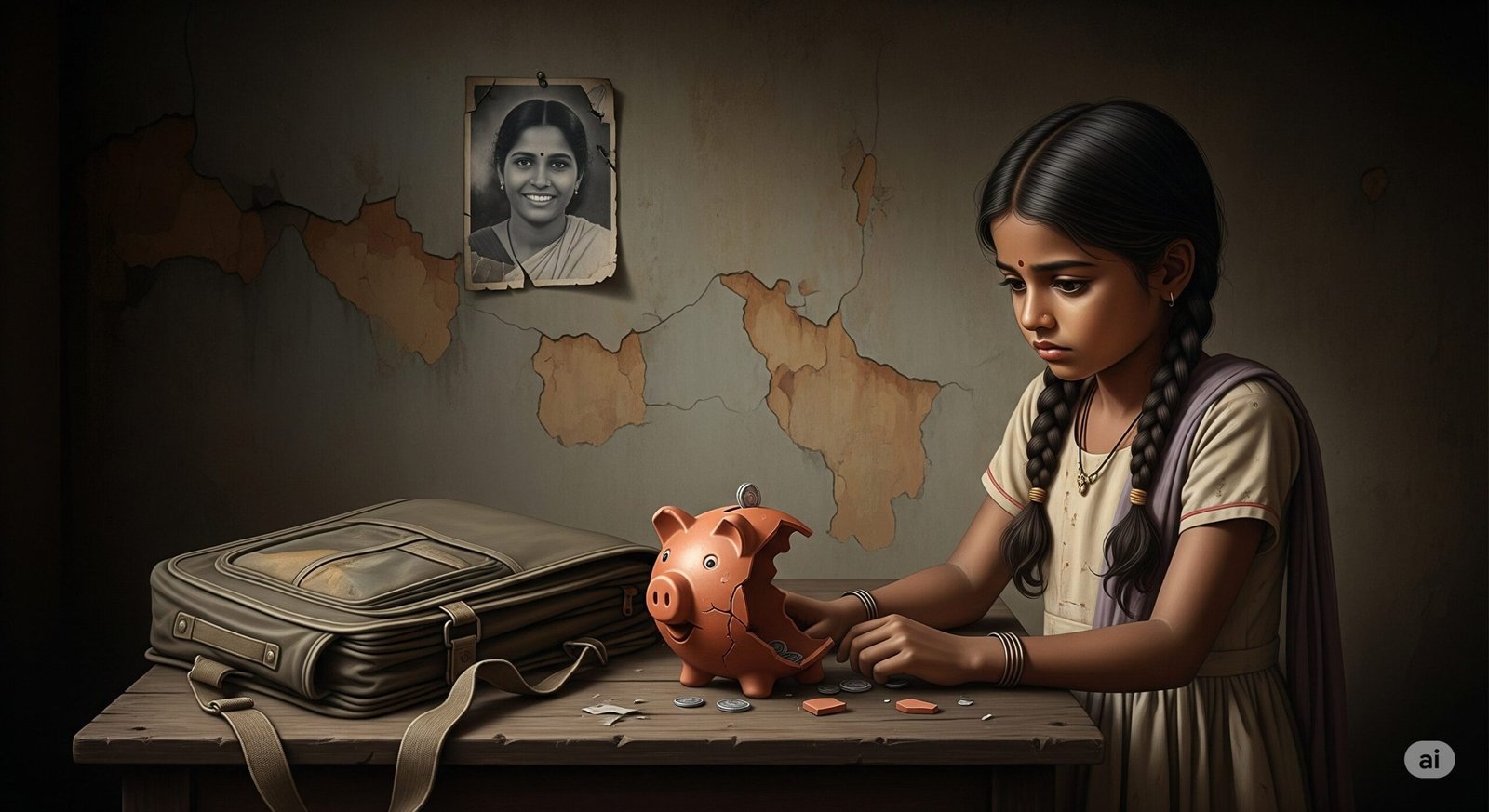
For a young girl in India, a mother’s death is more than an emotional tragedy; it is an earthquake that often triggers a devastating economic collapse after a mother’s death. The warmth of a mother’s care is suddenly replaced by the cold reality of financial instability, a burden that falls disproportionately on her daughter’s shoulders. Personal stories speak of girls whose schooling ends overnight, their dreams sacrificed to manage a household left in chaos. This isn’t just grief; it’s the systematic dismantling of a girl’s future, a causal chain that pulls her from her classroom and pushes her towards a life of domestic servitude and early marriage, fueling a cycle of intergenerational poverty.
The Cost of Losing a Mother
Economic Collapse
A mother’s death often triggers a financial vacuum, plunging the family into poverty and forcing the daughter to drop out of school.
Identity Crisis
Without her primary role model, a girl struggles with low self-esteem and the feeling of being unlovable or helpless.
Cycle of Poverty
Forced into domestic servitude and early marriage, the daughter’s future is sacrificed, locking in poverty for the next generation.
From Classroom to Kitchen: The Burden of Domestic Servitude
In the harsh reality of a grieving and financially broken patriarchal family, a daughter is often seen as the most expendable asset. While all older children are likely to be pulled from school to save money, this burden falls overwhelmingly on girls. In a culture that often views a daughter as ‘paraya dhan’ (another’s wealth), her education is seen as a poor investment compared to a son’s. Her schooling is, therefore, the first thing to be sacrificed. A recent report by CRY (Child Rights and You) found that adolescent girls who lose their mothers are nearly twice as likely to be engaged in full-time domestic labor compared to their peers. She is expected to immediately step into her mother’s role, taking on a crushing burden of domestic servitude that ends any possibility of a future she might have imagined.
For many of these girls, the only viable options that remained were early marriage and early motherhood.
An Identity Crisis in Girls: The Internal Collapse
The economic collapse after a mother’s death is matched by an equally profound internal collapse. In India’s patriarchal society, a mother’s absence deeply affects a girl’s sense of identity and self-worth. Without her primary guide and role model, she faces feelings of abandonment, which leads to low self-esteem and the painful belief that she is unlovable or helpless. One motherless daughter anonymously shared, “I felt unworthy of love without my mother’s presence,” a feeling that captures this deep internal void. Cultural expectations often force her to take on her mother’s role too soon, which completely disrupts her own identity formation. She becomes a caregiver before she has had the chance to be a child. This creates a lasting identity crisis in girls, leaving them to navigate life without a map for who they are meant to become.
38% Poverty Rate
According to a UN Women report, the poverty rate of lone-mother households in India is 38%, compared to 22.6% for dual-parent households, highlighting the economic devastation of maternal loss.
A Transactional Fate: Early Marriage and Intergenerational Poverty
The same cold economic logic that ends a daughter’s education also determines her marital fate. For many of these girls, early marriage becomes the only option. Marrying her off serves two purposes for the struggling family: it reduces the number of mouths to feed and removes a dependent. Her future is systematically sacrificed to stabilize the family unit. The daughter is treated as a transaction, a way to create a new economic alliance or simply a burden to be relieved. This direct path from maternal death to financial instability to the end of a daughter’s education and her child marriage is a powerful engine for intergenerational poverty. The mother’s death sentences the daughter to a shortened life, ensuring that the cycle of poverty, poor health, and limited opportunity continues for another generation.
I felt unworthy of love without my mother’s presence.
Breaking the Cycle of Loss and Poverty
The cycle of poverty fueled by maternal loss is not unbreakable. Interventions that focus on keeping girls in school, even after a family crisis, are critical. Organizations that provide financial support or educational resources can help mitigate the economic pressure that forces girls into domestic servitude. Furthermore, creating support systems that address the identity crisis in girls can help rebuild their self-esteem. Mentorship programs, peer support groups, and access to counseling can provide the guidance and validation that was lost with their mother. By addressing both the economic and emotional fallout, we can empower these girls to reclaim their futures and break the cycle of intergenerational poverty for themselves and for the next generation.
9 in 10
Abandoned Children are Girls
According to UNICEF data, of the 11 million abandoned children in India, a staggering nine out of ten are girls, a reflection of the deep-seated cultural devaluing that makes them most vulnerable after an economic collapse.
A mother’s death is a profound loss that can trigger a devastating economic collapse, pushing her daughter into a life of hardship. By understanding the deep connection between this financial crisis, the loss of identity, and the cycle of poverty, we can create more effective support systems. It is our collective responsibility to ensure that the loss of a mother does not mean the loss of a daughter’s future.